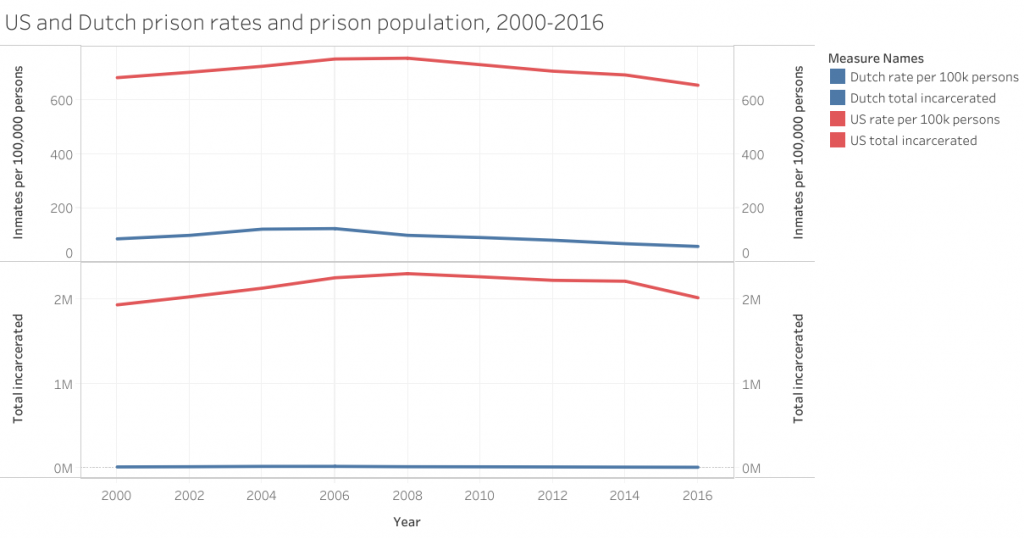
Consistently, the US justice system favors the prison system as punishment for those charged as criminals. Without alternatives, this system ultimately results in high recidivism rates, compared to other countries. Dutch prisons have a low recidivism rate, at 27.5% in 2008 having declined from 30.8% over 6 years (Wartna et al. 2011).The Dutch prison rate and population has also dropped, down to 59 per 100,000 people in prison with a total population of 10,115 in 2016 (WPB 2018). These numbers are far smaller than the US rates. A study conducted over 30 states shows that in the US, more than two-thirds of prisoners are rearrested within three years (Durose et al. 2014). The US rate of incarceration sits at a high 716 per 100,000 people (Subramanian & Shames 2013). Through a combination of factors, like sentencing alternatives and avoiding punitive measures, the Dutch have reduced recidivism to the point prisons are being closed down. Tackling recidivism by way of shorter sentencing and non-punitive treatment is a more effective solution to lowering crime rates than “tough on crime” measures.
The Dutch prison model is less isolating than the US model. Being in prison and cut off from society is the punishment in the Netherlands, and the law holds that prisoners should not experience further punishment in the prison itself (Subramanian & Shames 2013). Prisoners are allowed to interact with each other and with the guards (Subramanian & Shames 2013). Relationships between prisoners are encouraged, with many sharing the same living spaces (Kenis et al. 2010). The practices of normalization and resocialization mean prisoners, though apart from “normal” society, have meaningful relationships within prison.
In the Netherlands, nearly all sentences are four years or less (Subramanian & Shames 2013). Dutch law does not give specific minimums for given crimes, but incarceration sentences are generally capped at 15 years (OJP 1977). Many sentences are not served fully in prison (Subramanian & Shames 2013). The US, on the other hand, has mandatory minimums, which give the judge little discretion in the treatment of a charged person (Wasif 2019). If a certain charge’s mandated minimums say a guilty person must go to jail for at least 7 years, there isn’t much room to argue against it. These minimum sentences can even be extended by the prosecution, in certain cases (Wasif 2019). Drug offenders in the US, who are affected by many of these mandatory minimums, are rearrested within five years of release in over 75% of cases (Durose et al. 2014). This kind of sentencing practice neglects differences of circumstance between individuals and demands universal, highly punishing sentences. Dutch policy avoids long sentences when individuals are sent to prison and favors alternatives to incarceration.
There are important sentencing alternatives in the Netherlands, which keep individuals charged with criminal offenses out of prison entirely. Dutch lawmakers have implemented TBS–Terbeschikkingstelling, or detention under hospital orders. A mentally ill individual charged with a crime is given extended treatment at a clinical ward, under the assumption the root of their offense lies in their mental health (Van Marle 2002). TBS wards are continually improved as well, with possible improvements in new forms of therapy in lowering recidivism (Bernstein et al. 2012). In the US, between 30 and 60% of prisoners have some form of PTSD and prison itself can be traumatic (Wolff et al. 2014). Prison causes harm to individuals’ mental wellbeing. TBS keeps individuals out of a regular prison and lowers their risk of committing another criminal offense.
These factors reduce the prison population and recidivism rates heavily, which is the main objective of these policies. Most crime in the Netherlands is due to repeat offenders (Van Marle 2002). This is true in the US as well (Durose et al. 2014). Those charged with criminal offense and punished for it are often left in positions that make them liable to be charged again. The United States does have forms of therapy for prisoners, namely cognitive behavioral therapy (CBT), but these practices have not shown to be universally effective when implemented (Howle 2018). CBT involves a wide range of therapies designed to assist an individual in understanding and changing their behaviors for self-improvement (Feucht & Holt 2016). It has been shown to be effective in reducing “problematic behaviors,” particularly among juveniles, but it is used for a wide array of criminal offenses (Feucht & Holt 2016). Researchers comparing the treatment’s general effectiveness noted problems in comparing all CBT treatments, as the subjects and aims of various CBT treatments differ (such as between juveniles and adults, or drug use prevention and crime prevention (Feucht and Holt 2016)). In California prisons, there are major issues with CBT administration, as CBT treatment is either not completed or not administered at all for those who need it (Howle 2018).
The US could reduce its recidivism rate if policies like those in the Netherlands were implemented and those that we have implemented now were more effective. Reliance on alternatives to prison would reduce crime, and the benefit to creating non-carceral measures has been seen in the Netherlands already (Subramanian & Shames 2013). With reoffenders composing the majority of individuals charged with a criminal offense, policies which are focused on lowering recidivism instead of punishment focused are necessary to effectively deal with criminal issues.
References
Bernstein, David, Henk Nijman, Kai Karos, Marije Keulen-de Vos, Viviënne de Vogel, and Tanja Lucker. 2012. “Schema Therapy for Forensic Patients with Personality Disorders: Design and Preliminary Findings of a Multicenter Randomized Clinical Trial in the Netherlands.” International Journal of Forensic Mental Health 11(4): 312-324.
Durose, Matthew, Alexia Cooper, and Howard Snyder. 2014. “Recidivism of Prisoners Released in 30 States in 2005: Patterns from 2005 to 2010 – Update.” Bureau of Justice Statistics. Retrieved February 21st, 2021.
Feucht, Thomas, and Tammy Holt. 2016. “Does Cognitive Behavioral Therapy Work in Criminal Justice? A New Analysis From CrimeSolutions.” National Institute of Justice. Retrieved March 4th, 2021.
Howle, Elaine. 2018. “Several Poor Administrative Practices Have Hindered Reductions in Recidivism and Denied Inmates Access to In‑Prison Rehabilitation Programs.” California Department of Corrections and Rehabilitation. Retrieved February 22nd, 2021.
Kenis, Patrick, Peter Kruyen, J. Baaijens, and Peter Barneveld. 2010. “The Prison of the Future? An Evaluation of an Innovative Prison Design in the Netherlands” The Prison Journal 90(3). Retrieved February 18th, 2021.
Office of Justice Programs (OJP). 1977. “The Netherlands Prison System.” Central Recruitment and Training Institute of the Prison Service. Retrieved March 5th, 2021 (https://www.ojp.gov/pdffiles1/Digitization/52595NCJRS.pdf).
Subramanian, Ram and Alison Shames. 2013. “Sentencing and Prison Practices in Germany and the Netherlands: Implications for the United States.” Vera: Institute of Justice. Retrieved February 7th, 2021.
Van Marle, Hjalmar. 2002. “The Dutch Entrustment Act (TBS): Its Principles and Innovations.” International Journal of Forensic Mental Health 1(1):83-92. Retrieved February 21st, 2021.
Wasif, Rebecca. 2019. “Reforming Expansive Crime Control & Sentencing Legislation in an Era of Mass Incarceration: a National and Cross-national Study an Era of Mass Incarceration: a National and Cross-national Study.” University of Miami International and Comparative Law Review University of Miami International and Comparative Law Review 27 (1):175-200. Retrieved March 5th, 2021.
Wolff, Nancy, Jessica Huening, Jing Shi, B Frueh. 2014. “Trauma exposure and posttraumatic stress disorder among incarcerated men.” Journal of Urban Health 91(4):707-719. Retrieved February 9th, 2021 (doi:10.1007/s11524-014-9871-x).
World Prison Brief, Institute for Crime & Justice Policy Research. 2018. “United States of America.” WPB. Retrieved March 9th, 2021.
World Prison Brief, Institute for Crime & Justice Policy Research. 2018. “Netherlands.” WPB. Retrieved February 21st, 2021.
If you see this after your page is loaded completely, leafletJS files are missing.
